
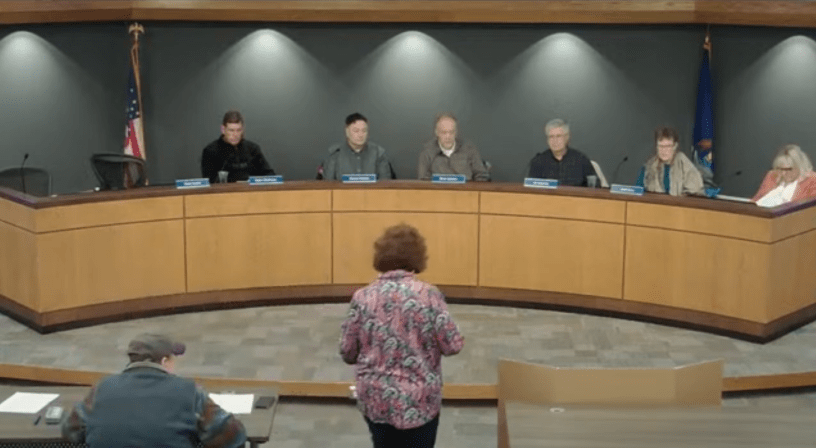
PLAINFIELD CHARTER TOWNSHIP, MI — April 8, 2025 — The Plainfield Township Planning Commission voted to approve a controversial 165-foot cell tower proposal on Pine Island Drive following extended legal debate and a strong wave of public opposition from neighboring residents.
Legal Gray Areas Overshadow Deliberations
The meeting, held Monday evening, centered on whether a lease agreement for the tower site constituted a land division under state law—a key point raised by opposing counsel representing several homeowners. The township attorney acknowledged the ambiguity and recommended conditional approval while the legal review continues. Planning commissioners emphasized repeatedly that many contentious issues, including easement disputes and private land agreements, fall outside their purview.
Despite unanswered legal questions, staff noted that similar leases for other infrastructure—such as billboards, solar panels, and cell towers—have not historically been treated as land divisions.
Residents Object to Land Use, Health, and Property Impact
Multiple residents and property owners voiced strong opposition during the public comment period. Concerns ranged from environmental impacts and stormwater runoff to potential property devaluation, privacy intrusion, and health risks associated with tower proximity.
Doug and Joy Edwards, whose property borders the proposed tower site, questioned the necessity of the structure, especially since the majority of increased coverage would benefit neighboring Alpine and Elma Townships. “We’re shouldering the burden for others’ benefit,” said Joy Edwards, noting the tower’s visibility from their bedroom window and citing a realtor’s estimate that it could slash property values by up to $50,000.
Other residents, including local attorney Nick Cersio, pressed the commission to reject the application on legal grounds, arguing the lease exceeded the one-year limit outlined in land division statutes and thus required subdivision approval. Several residents also cited inconsistencies in communication from the applicant and lack of environmental due diligence, particularly with regard to nearby wetlands.
Commission Pushes Forward Amid Constraints
While sympathetic to the residents’ frustrations, commissioners made clear that federal law significantly limits the reasons a municipality can deny a telecommunications proposal. Health concerns, for instance, fall under the exclusive jurisdiction of the FCC. Commissioners also noted that non-conforming uses and private road agreements were beyond the scope of their decision.
A staff representative confirmed the township’s planning history reflects similar approvals across other rural parcels and highlighted that the township is nearing full capacity for potential tower sites.
Ultimately, the commission approved the special use permit and site plan in a 7-0 vote, with added conditions related to tower lighting, equipment labeling, registration with co-location databases, and conditional compliance with land division laws.
Church Rezoning Garners Broad Support
The second item on the agenda was a rezoning application to convert a small, financially strained church property at 3931 Leland Avenue into a two-family residential unit. The applicant, Andrew Bame, and church representatives both emphasized the goal of affordable housing and minimal exterior alterations.
Commissioners and staff voiced support, citing similar church-to-residential transitions in the township and alignment with the master plan’s call for increased density near the Comstock Park commercial corridor. Minor concerns about parking availability and non-conforming setbacks were noted but deemed manageable.
The rezoning recommendation was unanimously passed and will now go before the Township Board for final approval.
Final Notes
During closing comments, several commissioners acknowledged the cell tower vote as difficult and reiterated the limits of their authority. Commissioner Marie summarized it succinctly: “It’s frustrating for the public, but many decisions are pre-empted by federal law.”
With this meeting, Plainfield Township illustrated the ongoing tension between local planning authority, federal preemption, and grassroots resistance. The commission’s decision sets a precedent likely to resonate in future infrastructure and land use debates.
 Grandwire