
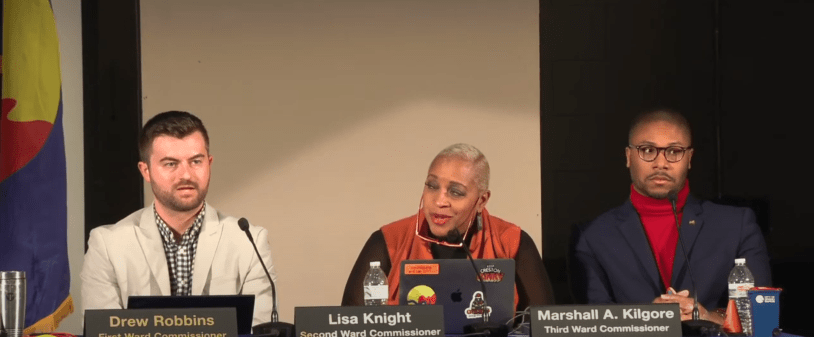
GRAND RAPIDS, MI — March 25, 2025 — At its latest Commission Night Out, held at Union High School, the Grand Rapids City Commission presented updates on infrastructure, zoning, and neighborhood investment initiatives. While commissioners touted recent actions as forward-thinking, lingering concerns from the community underscored a growing tension between city policy and public trust.
The meeting included the approval of two zoning changes: one to amend the Downtown Height Overlay District and another to revise the Grand River Overlay District and solar energy provisions. City officials framed these changes as necessary clarifications and sustainability upgrades. Commissioner Ysasi noted that removing administrative red tape for solar installations would ease the adoption of green technologies. Still, no formal analysis was shared to demonstrate how these changes will accelerate renewable energy adoption or affect neighborhood character.
City Manager Mark Washington announced that $7.5 million in federal funds will go toward housing and homelessness support programs. He also introduced a youth employment initiative targeting residents aged 15-24 with $13/hour part-time jobs. While both announcements were welcomed, details on how these funds would be distributed or evaluated for impact were notably sparse.
Several commissioners raised concerns about equity in city investments. Commissioner Ysasi highlighted the disparity between downtown development and underfunded neighborhood business districts. Her remarks implied an ongoing imbalance in capital distribution that city leadership has yet to adequately address. Commissioner Perdue reiterated the need for data-backed decision-making but offered limited specifics about how such data is currently informing city policy.
In financial matters, the commission approved a five-year extension for the Uptown Business Improvement District (BID) special assessment. Commissioner Kilgore abstained due to a potential conflict of interest. The decision reflects continued support for business corridors, but it also reignites questions about how and where the city chooses to channel its economic development resources.
Transparency and accountability—both frequently discussed topics—were addressed in general terms by several commissioners. In response to growing scrutiny over GRPD operations and community-police relations, Commissioner Knight spoke about the need for accurate information and civil engagement. However, there was no substantive follow-up on calls for specific police reforms or transparency metrics. Commissioner Belchak issued an apology for previously mischaracterized comments, but did not offer policy suggestions to address community concerns.
Budget discussions revealed division within the commission. Commissioner Ysasi opposed proposals to expand commissioner-specific budgets, warning of potential threats to city staffing amid federal budget uncertainty. Her remarks hinted at internal disagreements over spending priorities, though little was disclosed publicly about how such proposals had advanced behind the scenes.
The evening concluded with routine administrative actions and approval of correspondence filings. Commissioners expressed generalized optimism about the city’s direction but avoided direct responses to some of the more pointed community critiques voiced earlier in the evening.
As Grand Rapids moves into its next budget cycle, questions remain about whether the city’s strategic planning aligns with resident needs—particularly those in marginalized neighborhoods. The Commission Night Out format, designed to improve civic accessibility, succeeded in drawing attention to pressing local issues. Whether those concerns translate into tangible policy changes, however, is far from certain.
Watch the full video of the meeting at the link below.
 Grandwire